
data_processing
A repeated bar can overweight an observation; a missing bar can turn an apparent one-period
return into a multi-period return. openquant::data_processing prepares OHLCV observations
before bars, labels or features: sort and
deduplicate keys, inspect gaps, then optionally put each symbol onto an explicit time grid.
It is an ingestion utility rather than an AFML estimator. Its behavioral reference is the
repository’s data-processing implementation and tests, not a numbered book snippet.
Three representations, one implementation
Section titled “Three representations, one implementation”All nine functions use the same Polars implementation. Cleaned and aligned outputs are sorted by symbol, then timestamp. Report functions inspect a sorted copy without changing the input.
| Operation | Rows | Columns | Polars DataFrame |
|---|---|---|---|
| Sort and deduplicate | clean_ohlcv_rows(rows, keep_last) | clean_ohlcv_columns(columns, keep_last) | clean_ohlcv_df(df, keep_last) |
| Inspect without deduplicating | quality_report(rows, removed) | quality_report_columns(columns, removed) | quality_report_df(df, removed) |
| Regular calendar grid | align_calendar_rows(rows, seconds) | align_calendar_columns(columns, seconds) | align_calendar_df(df, seconds) |
Cleaning returns (cleaned_data, DataQualityReport). Alignment returns
(aligned_data, CalendarAlignmentReport). The column and DataFrame forms return Result;
the row cleaner and quality_report return their values directly and can panic on an
underlying Polars failure. align_calendar_rows returns Result too.
| Representation | Input contract | Aligned output |
|---|---|---|
OhlcvRow | timestamp: chrono::NaiveDateTime interpreted as UTC, symbol: String, six f64 fields: open, high, low, close, volume, adj_close | AlignedOhlcvRow: the same key, six Option<f64> fields, is_missing_bar: bool |
OhlcvColumns | timestamps_us: Vec<i64> since the Unix epoch in UTC, symbols: Vec<String>, six Vec<f64> fields; all eight vectors must have equal length | AlignedOhlcvColumns: six Vec<Option<f64>> fields and is_missing_bar: Vec<bool> |
DataFrame | Required columns symbol (String), ts_us (Int64 epoch microseconds), and the six OHLCV fields (Float64) | Same columns with nullable OHLCV values, plus Boolean is_missing_bar |
Rust expects this schema already prepared: it does not parse timestamp strings, resolve
column aliases, supply adj_close, or convert local wall time to UTC. Convert timezones
before constructing rows, and retain microsecond precision when moving between forms.
Required names are checked, and key types are accessed as String/Int64; this is not an
exhaustive dtype or value validator for the six numerical columns. In particular the
DataFrame cleaner/report can pass through numerical columns without casting them.
One duplicate, one missing weekday
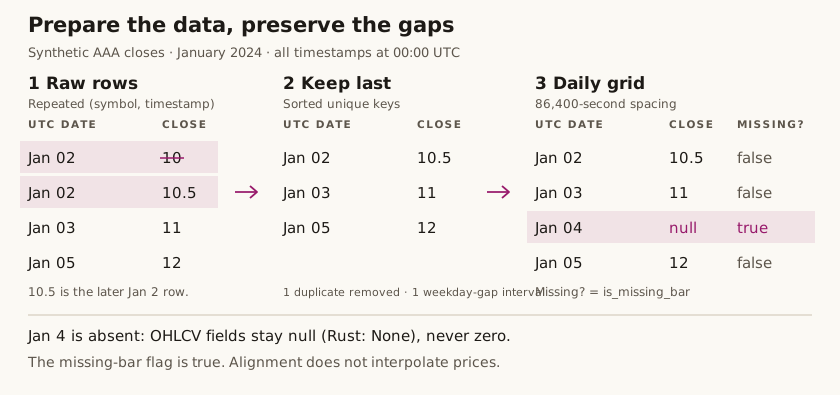
Section titled “One duplicate, one missing weekday”This deliberately tiny fixture is synthetic. January 2 has two observations for AAA, in
input order; January 4 has none. A duplicate means the same symbol and timestamp,
regardless of whether prices agree. keep_last = true retains 10.5; false retains 10.0.
Stable sorting preserves input order among equal keys, so this choice is deterministic.
use chrono::NaiveDate;use openquant::data_processing::{    align_calendar_rows, clean_ohlcv_rows, quality_report, DataProcessingError, OhlcvRow,};
let bar = |day, close| OhlcvRow {    timestamp: NaiveDate::from_ymd_opt(2024, 1, day).unwrap().and_hms_opt(0, 0, 0).unwrap(),    symbol: "AAA".to_string(),    open: close,    high: close,    low: close,    close,    volume: 1.0,    adj_close: close,};let rows = vec![bar(2, 10.0), bar(2, 10.5), bar(3, 11.0), bar(5, 12.0)];let raw_report = quality_report(&rows, 0);assert_eq!(raw_report.row_count, 4);assert_eq!(raw_report.duplicate_key_count, 1);
let (clean, report) = clean_ohlcv_rows(&rows, true);assert_eq!(clean.iter().map(|r| r.close).collect::<Vec<_>>(), [10.5, 11.0, 12.0]);assert_eq!(clean_ohlcv_rows(&rows, false).0[0].close, 10.0);assert_eq!(report.duplicate_key_count, 0);assert_eq!(report.rows_removed_by_deduplication, 1);assert_eq!(report.inferred_interval_us, Some(86_400_000_000));assert_eq!(report.gap_interval_count, 1);// Report-only calls carry forward the supplied removal count.assert_eq!(quality_report(&clean, 1), report);
let (aligned, alignment) = align_calendar_rows(&rows, 86_400)?;let missing: Vec<bool> = aligned.iter().map(|r| r.is_missing_bar).collect();assert_eq!(missing, [false, false, true, false]);assert_eq!(aligned[2].timestamp, bar(4, 0.0).timestamp);assert_eq!(aligned[2].close, None);assert_eq!(alignment.rows_removed_by_deduplication, 1);assert!(alignment.off_grid_bars.is_empty());
// A two-day grid starts on Jan 2: Jan 3 and Jan 5 do not land on it.let (coarse, omitted) = align_calendar_rows(&rows, 172_800)?;assert_eq!(coarse.len(), 2); // Jan 2, Jan 4; no rounding or aggregationassert_eq!(coarse[0].close, Some(10.5));assert_eq!(coarse[1].close, None);assert_eq!(omitted.off_grid_bars, vec![    ("AAA".to_string(), bar(3, 0.0).timestamp),    ("AAA".to_string(), bar(5, 0.0).timestamp),]);assert!(matches!(align_calendar_rows(&rows, 0), Err(DataProcessingError::NonPositiveInterval)));println!("raw={} clean={} removed={} gaps={}",    raw_report.row_count, report.row_count, report.rows_removed_by_deduplication,    report.gap_interval_count);println!("daily missing={missing:?}; two-day off-grid={}", omitted.off_grid_bars.len());
raw=4 clean=3 removed=1 gaps=1daily missing=[false, false, true, false]; two-day off-grid=2The snippet is executed in crates/openquant/tests/docs_data_processing.rs, in addition to
the site’s Rust compilation check. Its expected values follow directly from the four
input rows and the January 2024 weekday calendar.
Reading a quality report
Section titled “Reading a quality report”DataQualityReport contains eight fields:
| Field | Meaning |
|---|---|
row_count, symbol_count | Observations and distinct symbols in the inspected data |
duplicate_key_count | Extra rows sharing a key; three equal keys contribute two, not one; zero after cleaning |
inferred_interval_us | Most common positive within-symbol spacing, pooled over symbols; smallest spacing wins ties; None if there are no positive spacings |
gap_interval_count | Consecutive within-symbol intervals that qualify as gaps; not the number of absent bars |
ts_min, ts_max | Earliest and latest UTC NaiveDateTime, None for empty input |
rows_removed_by_deduplication | Computed by cleaning; passed through unchanged from removed by report-only functions |
Zero spacings from duplicates do not participate in inference. In the example, one-day and two-day spacings tie, so the inferred interval is one day. No symbol contributes a spacing to another symbol, but the final inferred interval is shared across the dataset. A mixed-frequency dataset can therefore produce misleading gaps; inspect frequencies separately when that matters.
For an inferred interval within one hour of 24 hours (inclusive), a gap means at least one skipped Monday–Friday UTC date strictly between two bars. Friday to Monday is not a gap; Friday to Tuesday is one. Exchange holidays count as skipped weekdays because no holiday calendar is consulted. The one-hour tolerance accommodates daily spacing shifts around daylight saving time; it does not introduce an exchange timezone or session model.
For every other inferred frequency, a gap is simply a positive spacing longer than that inferred interval. Intraday overnight and weekend breaks therefore count. With no inferred interval, the count is zero. A sparse series with only two distinct timestamps can infer its entire separation as the normal interval: the report does not know your intended frequency and cannot certify completeness.
Alignment is a grid, not a trading calendar
Section titled “Alignment is a grid, not a trading calendar”Each symbol is first cleaned with keep last, then independently reindexed from its own
first timestamp to its last, in positive interval_seconds steps. The last timestamp is
included only if it falls on that grid. Daily grids include weekends and holidays; symbols
need not share a start, end or grid phase. There is no resampling, price aggregation,
interpolation, forward fill, or common cross-symbol date range.
Missing grid points have null values for all six OHLCV fields, including volume.
CalendarAlignmentReport.rows_removed_by_deduplication counts input duplicate rows removed;
off_grid_bars lists (String, NaiveDateTime) keys of remaining off-grid observations,
sorted by symbol and time. Those observations are absent from the output. Always inspect
this report before treating an aligned dataset as complete, especially after changing
intervals or time-of-day conventions.
For DataFrames, is_missing_bar is implemented as open is null. Consequently a
pre-existing row with a null opening price also receives true; it is not exclusively a
join-provenance indicator. OhlcvRow and OhlcvColumns cannot contain null prices, so their
new nulls represent missing grid bars. NaN is a floating-point value, not a null.
Python uses the data schema
Section titled “Python uses the data schema”There is no Python data_processing module. The existing openquant.data
helpers expose related cleaning, reporting and alignment operations, with their own schema
normalization. They are implemented independently in Python/Polars rather than dispatching
to these Rust functions. They use ts as a Polars datetime, not Rust’s Int64 ts_us, and accept
aliases and a missing adj_close. Null canonical rows are dropped during Python cleaning;
Rust DataFrame cleaning does not offer that normalization. This is a companion API example,
not an additional binding to the nine Rust entry points.
import polars as plfrom openquant import data
prices = [10.0, 10.5, 11.0, 12.0]raw = pl.DataFrame({    "ts": ["2024-01-02", "2024-01-02", "2024-01-03", "2024-01-05"],    "symbol": ["AAA"] * 4,    "open": prices, "high": prices, "low": prices, "close": prices,    "volume": [1.0] * 4,})clean, report = data.clean_ohlcv(raw, return_report=True)aligned, alignment = data.align_calendar(raw, interval="1d", return_report=True)assert clean["close"].to_list() == [10.5, 11.0, 12.0]assert report["rows_removed_by_deduplication"] == 1assert report["gap_interval_count"] == 1assert aligned["close"].to_list() == [10.5, 11.0, None, 12.0]assert alignment["off_grid_bar_count"] == 0print("Python data closes:", aligned["close"].to_list())
Python data closes: [10.5, 11.0, None, 12.0]Python reports are dictionaries; their timestamp bounds are strings and their alignment
report contains a DataFrame of omitted bars plus off_grid_bar_count. Rust reports use
the typed structs above. See data for loading, cache provenance, wrapper
null handling and the Python API reference.
Errors and limits
Section titled “Errors and limits”DataProcessingError has four variants:
| Variant | Cause |
|---|---|
Frame { context, reason } | Missing required column, an accessed column’s wrong dtype, a failed Polars operation, or an out-of-range off-grid timestamp |
NullValue { column, row } | Null symbol or ts_us; row is in sorted order |
LengthMismatch(String) | Unequal column-vector lengths, with lengths in the message |
NonPositiveInterval | Alignment interval is zero or negative |
Empty, correctly shaped inputs are supported: reports have zero counts and None bounds
and interval (preserving a report-only removal count); alignment adds an empty missing-bar
flag. Prices, volume, OHLC ordering, finiteness and economic plausibility are not validated.
Cleaning does not repair prices or adjust corporate actions; adj_close is supplied data.
Use representable UTC timestamps and practical positive intervals: positivity is checked, but interval-to-microsecond multiplication and timestamp arithmetic are not generally protected against overflow. Extremely small intervals over long histories can allocate very large grids. The wrappers materialize Polars data; the row and column APIs are convenience representations, not streaming or zero-copy interfaces.
The behavioral tests are in
crates/openquant/tests/data_processing.rs,
including frequency inference, weekday and intraday gaps, stable first/last selection,
and off-grid reports. After hygiene, data structures
constructs event bars and filters selects events for labeling.
API reference
Section titled “API reference”Rustdoc for this commit, with every public item of openquant::data_processing (after a crates.io release the same pages are on docs.rs):