
streaming_hpc
An early warning is worth something only if it arrives before the event it warns of. AFML’s Chapter 22, written by Horst Simon and Kesheng Wu, tells how their group at Lawrence Berkeley computed two indicators that had shown warning signs ahead of the Flash Crash of 6 May 2010 — VPIN, the volume-synchronised probability of informed trading, and a variant of the Herfindahl–Hirschman index of market fragmentation — over ten years of S&P 500 trades, and made the computation fast enough to matter.
This module keeps both indicators as incremental state. Each event updates them in constant time, memory stays bounded however long the stream runs, and an alert fires when VPIN is high relative to its own recent history and HHI is above its threshold at the same time.
The two indicators
Section titled “The two indicators”VPIN measures how one-sided the order flow is, on a volume clock (Easley, López de Prado and O’Hara, 2011, 2012). Trades are poured into buckets of a fixed volume ; an event that overflows a bucket is split between it and the next, keeping its buy/sell ratio. For bucket with buy volume and sell volume ,
over the last = support_buckets full buckets. It is 0 when every bucket is balanced and
1 when every bucket is all buying or all selling. Because buckets are equal-volume, a burst of
trading fills buckets faster and VPIN reacts in fewer events, which is the point of the
volume clock.
HHI measures how concentrated trading is across venues (Hirschman, 1980). With the
volume traded on venue over the last = lookback_events events,
It is when venues share the volume evenly and 1 when one venue has all of it.
The alert does not compare VPIN with a fixed level. As in the chapter’s calibration
(§22.6.5, following Easley, López de Prado and O’Hara, 2011), it uses the cumulative
distribution function of VPIN: is the rank of the current VPIN among its
last cdf_lookback values, one recorded per completed bucket, current value included, with
ties counting half. A threshold such as therefore means “VPIN is in the top 1%
of its recent history”, which adapts to each instrument’s normal level of toxicity. The alert
fires when and .
normalized_risk_score is ,
so it is at least 1 exactly when the alert fires. The CDF and the score are None, and the
alert is false, until VPIN has full buckets and cdf_lookback values of history and HHI
has events.
A synthetic flash crash
Section titled “A synthetic flash crash”generate_synthetic_flash_crash_stream produces a deterministic stream for calibration.
Before the crash, events rotate over calm_venues venues with 120 bought and 130 sold, and the
price drifts up by 0.01% per event. From the crash on, every event is on shock_venue with 80
bought and 320 sold, and the price falls 0.25% per event.
from openquant import streaming_hpc
# 1,000 events, 1 ms apart. Calm flow rotates over four venues; from event 700 all# flow is on venue 0 and four-fifths of it is selling.events = streaming_hpc.generate_synthetic_flash_crash_stream(    events=1000, crash_start_fraction=0.7, calm_venues=4, shock_venue=0)report = streaming_hpc.run_streaming_pipeline(    events,    bucket_volume=1000.0,  # VPIN bucket size, in units of volume    support_buckets=10,  # VPIN averages the last 10 full buckets    lookback_events=50,  # HHI takes venue volume shares over the last 50 events    cdf_lookback=100,  # VPIN's CDF is taken over its last 100 values    vpin_cdf_threshold=0.99,    hhi_threshold=0.5,)
def show(x):    return "   none" if x is None else f"{x:7.3f}"
print("event    price     vpin  cdf(vpin)      hhi    score  alert")for i in (0, 49, 434, 435, 699, 702, 715, 722, 723, 728, 729, 750, 999):    ts, price, vpin, hhi, score, alert, vpin_cdf = report["snapshots"][i]    print(        f"{i:5d}  {price:7.2f}  {show(vpin)}    {show(vpin_cdf)}  {show(hhi)}  {show(score)}  {alert}"    )
alerts = [i for i, s in enumerate(report["snapshots"]) if s[5]]print("alerts at events", alerts[0], "to", alerts[-1], "- the crash began at event 700")print("alerts:", report["alert_count"])
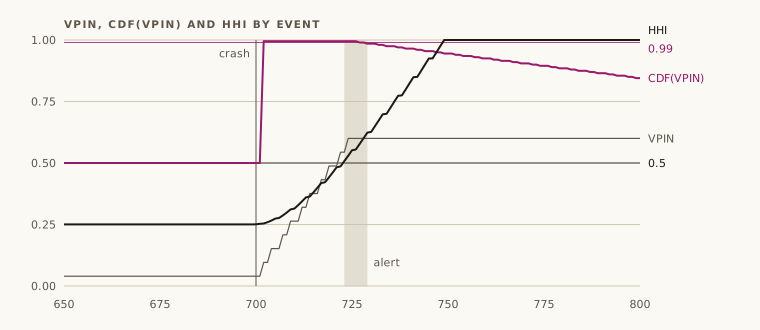
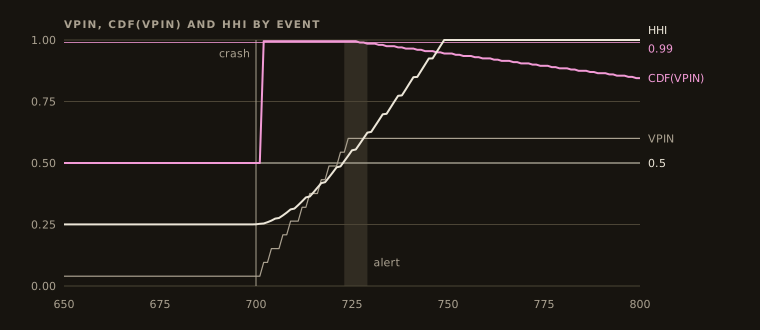
event price vpin cdf(vpin) hhi score alert 0 100.01 none none none none False 49 100.50 0.040 none 0.250 none False 434 104.45 0.040 none 0.250 none False 435 104.46 0.040 0.500 0.250 0.501 False 699 107.25 0.040 0.500 0.250 0.501 False 702 106.45 0.096 0.995 0.254 0.508 False 715 103.04 0.376 0.995 0.381 0.763 False 722 101.25 0.544 0.995 0.486 0.972 False 723 101.00 0.544 0.995 0.508 1.005 True 728 99.74 0.600 0.990 0.601 1.000 True 729 99.49 0.600 0.985 0.624 0.995 False 750 94.40 0.600 0.945 1.000 0.955 False 999 50.61 0.600 0.500 1.000 0.505 Falsealerts at events 723 to 728 - the crash began at event 700alerts: 6The calm stream has VPIN and HHI (printed as 0.250). The venues take turns, so the last 50 events split 13/13/12/12 across the four venues rather than exactly a quarter each: . VPIN needs 10,000 units of volume, 40 events, before it reports; its CDF needs 100 more values, one per bucket, and first reports at event 435. On a perfectly steady stream every value ties, so the CDF sits at 0.5. Two events into the crash, VPIN moves above everything in its history and the CDF jumps to its ceiling, . HHI is slower: crash events carry more volume, but venue 0 still needs until event 723 to push HHI past 0.5, and the alert waits for it.
The alert then lasts six events. VPIN settles at by event 724, and every bucket after that adds another 0.6 to the history. Tied values count half, so the CDF of a constant VPIN falls: below 0.99 at event 729, and back to 0.5 once the plateau fills the whole history. A rolling CDF flags a jump in VPIN relative to its recent past, not how long VPIN stays high.
From Rust
Section titled “From Rust”StreamingEarlyWarningEngine::on_event is the incremental interface; run_streaming_pipeline
loops it over a slice and times each call. run_streaming_pipeline_parallel runs many
independent streams on hpc_parallel, one stream per atom, and
keeps only a summary of each.
use openquant::hpc_parallel::{ExecutionMode, HpcParallelConfig, PartitionStrategy};use openquant::streaming_hpc::{    generate_synthetic_flash_crash_stream, run_streaming_pipeline_parallel, AlertThresholds,    HhiConfig, StreamEvent, StreamingEarlyWarningEngine, StreamingHpcError,    StreamingPipelineConfig, SyntheticStreamConfig, VpinConfig,};
let cfg = StreamingPipelineConfig {    vpin: VpinConfig { bucket_volume: 1_000.0, support_buckets: 10, cdf_lookback: 100 },    hhi: HhiConfig { lookback_events: 50 },    thresholds: AlertThresholds { vpin_cdf: 0.99, hhi: 0.5 },};let stream_with_crash_at = |fraction: f64| {    generate_synthetic_flash_crash_stream(SyntheticStreamConfig {        events: 1_000,        crash_start_fraction: fraction,        calm_venues: 4,        shock_venue: 0,    })};
// Event by event: the engine holds only its two rolling windows.let stream = stream_with_crash_at(0.7)?;let mut engine = StreamingEarlyWarningEngine::new(cfg)?;let mut first_alert = None;for (i, event) in stream.iter().enumerate() {    if engine.on_event(*event)?.is_alert && first_alert.is_none() {        first_alert = Some(i);    }}assert_eq!(first_alert, Some(723));
// A bad tick is rejected before it touches the state.let bad = StreamEvent { price: f64::NAN, ..stream[0] };assert!(matches!(engine.on_event(bad), Err(StreamingHpcError::InvalidEvent(_))));
// Eight streams, crashing at events 100, 200, ..., 800, on four threads.let streams =    (1..=8).map(|k| stream_with_crash_at(k as f64 / 10.0)).collect::<Result<Vec<_>, _>>()?;let parallel = HpcParallelConfig {    mode: ExecutionMode::Threaded { num_threads: 4 },    partition: PartitionStrategy::Linear,    mp_batches: 1,    progress_every: 1,};let report = run_streaming_pipeline_parallel(&streams, cfg, parallel)?;// One summary per stream, in input order. VPIN's CDF needs a history of 100 values. In the// streams that crash at events 100 to 300 it fills only after VPIN has reached its plateau,// so the jump is never ranked and they never alert. The others alert for six events, 23 to// 28 events after their crash.let alerts: Vec<usize> = report.stream_summaries.iter().map(|s| s.alert_count).collect();assert_eq!(alerts, [0, 0, 0, 6, 6, 6, 6, 6]);assert_eq!(report.stream_summaries[0].latest_hhi, Some(1.0));
What to watch for
Section titled “What to watch for”- The CDF flags jumps, not persistence. VPIN’s CDF is taken over a rolling history of
cdf_lookbackvalues. Once a sustained high-VPIN regime fills that history it becomes the new normal, and the CDF falls back toward 0.5 even though VPIN is still high; in the example the alert lasts six events. Choosecdf_lookbacklong relative to the episodes you want to cover, and remember the CDF reports nothing until the history is full: a crash that comes before that is never ranked, as the first three streams in the Rust example show. vpin_cdfis a probability, not a VPIN level. Because ties count half, the largest value the CDF can take is (0.995 for 100). A threshold above that, or outside , could never fire and is rejected. Likewise the HHI threshold must be in , since the HHI never exceeds 1. The parallel runner checks the config once, up front, and reports a bad one asInvalidConfig.- Buy and sell volume are inputs. VPIN needs every trade signed, and the chapter’s
best parameters use bulk volume classification over bars. This module classifies nothing;
it trusts
buy_volumeandsell_volumeas given. Seemicrostructural_featuresfor bulk volume classification (get_bvc_buy_volume) and a bar-based VPIN over a finished history. - The three windows run on different clocks. VPIN’s window is
support_buckets × bucket_volumeunits of volume, its CDF’s history iscdf_lookbackbuckets (cdf_lookback × bucket_volumeunits of volume), and HHI’s window islookback_eventsevents. When volume per event changes, as in the crash above, one reacts faster than another, and the AND rule makes the alert as slow as the slowest. - The latency metrics time the engine, not your pipeline.
avg_event_latency_microsandmax_event_latency_microsare wall-clock times ofon_eventcalls, which take around a microsecond each; they vary from run to run and exclude parsing, queueing and I/O. - The parallel runner returns summaries only.
run_streaming_pipeline_parallelkeeps the alert count and the last snapshot of each stream; to see the path of each stream, callrun_streaming_pipelineper stream. Parallelism is across streams; a single stream is sequential by nature. It is Rust-only. - The synthetic stream is a switch, not a model. Two fixed regimes and a hard change
between them make it good for checking wiring and reaction time, and useless for estimating
false-positive rates. The chapter’s point about calibration — 20% false positives cut to 7%
over a hundred futures contracts by choosing parameters on the whole universe — needs real
data. If
shock_venueis one of the calm venues, as here, HHI starts from that venue’s existing share and crosses sooner than for a new venue.
Related modules
Section titled “Related modules”microstructural-features— VPIN and other flow features over bars, and trade classification.hpc-parallel— the engine behindrun_streaming_pipeline_parallel.structural-breaks— tests for regime change in a price series, the other family of early-warning statistics in the book.
API reference
Section titled “API reference”Python
Section titled “Python”Signatures, parameters, return values and errors for every function: openquant.streaming_hpc.
streaming_hpc.run_streaming_pipeline— Run the VPIN/HHI early-warning engine over a stream of events, one snapshot per event.streaming_hpc.generate_synthetic_flash_crash_stream— Generate a deterministic two-regime event stream loosely modelled on the 2010 Flash Crash.
Rustdoc for this commit, with every public item of openquant::streaming_hpc (after a crates.io release the same pages are on docs.rs):
StreamEventVpinConfigVpinStateHhiConfigHhiStateAlertThresholdsStreamingPipelineConfigStreamingEarlyWarningEngineEarlyWarningSnapshotrun_streaming_pipelineStreamingRunReportStreamingRunMetricsrun_streaming_pipeline_parallelParallelStreamingReportStreamSummarySyntheticStreamConfiggenerate_synthetic_flash_crash_streamStreamingHpcError